
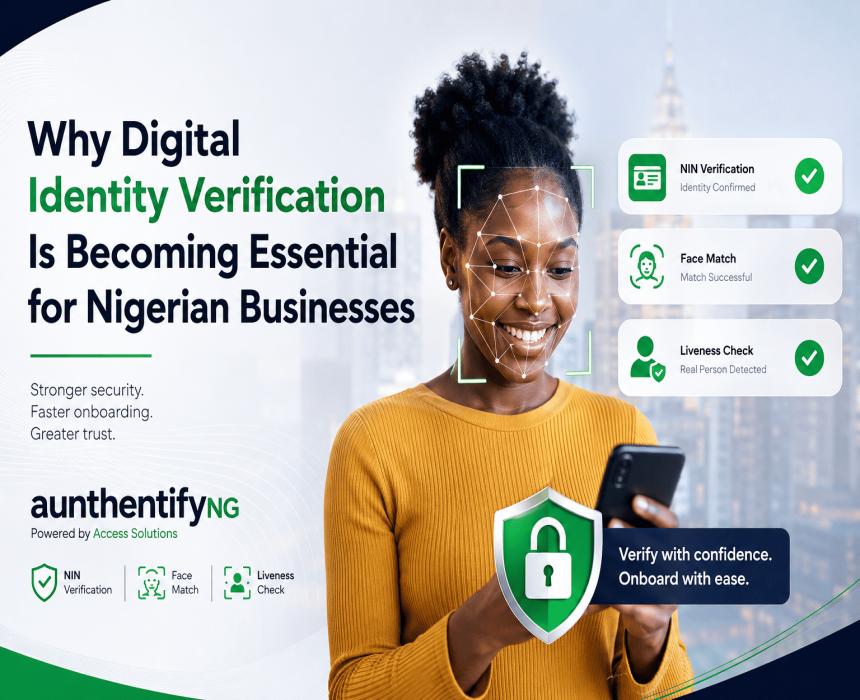
Imagine this.
A new customer discovers your business online, fills out a registration form, submits their details and is ready to start using your service.
Sounds simple, right?
But there is one question your business cannot afford to ignore:“How do we know this person is really who they say they are?”
That is wheredigital identity verification comes in.
As more Nigerian businesses move their services online, verifying the identity of customers is no longer something only banks and financial institutions need to worry about. Fintechs, telecom companies, e-commerce businesses, insurance companies, government agencies and other digital platforms all need reliable ways to know who is on the other side of the screen.
And with fraud becoming increasingly sophisticated, simply collecting a name, phone number or ID number may not be enough anymore.
What Is Digital Identity Verification?
Digital identity verification is the process of confirming that a person is genuinely who they claim to be using digital technology.
Instead of asking a customer to physically walk into an office with documents in hand, businesses can verify their identity remotely.
Depending on the business and its requirements, this may involve checking an identity number, comparing a person's face with an official identity record, or checking whether the person presenting themselves is a real, live human being.
In Nigeria, theNational Identification Number (NIN) has become an important part of digital identity verification.
But there is a big difference between simply collecting someone's NIN and actually verifying that the person behind the transaction is the legitimate owner of that identity.
That distinction matters.
Why Does Identity Verification Matter So Much?
Let's be honest: nobody likes filling out long forms, uploading documents and going through several verification steps just to use a service.
Businesses don't want to make onboarding difficult either.
But there is a delicate balance betweenmaking onboarding easy andkeeping your platform secure.
If verification is too weak, your business could be exposed to fraud and fake identities.
If it is too complicated, customers may abandon the registration process halfway through.
Good digital identity verification helps businesses find the middle ground:strong security without unnecessary friction.
Here are some of the biggest reasons it matters.
1. It Helps Prevent Identity Fraud
Identity fraud occurs when someone uses another person's personal information to pretend to be them.
Imagine someone gets hold of another person's identity details and uses them to open an account, access a service or carry out a transaction.
If your business only checks whether the information exists, that may not be enough.
You also need to ask, 'Is this actually the person associated with this identity?This is where technologies such asface matching and liveness detection become valuable.
Face matching can help compare a person's face with the image associated with their identity record, while liveness detection helps determine whether the person presenting the face is actually present rather than someone holding up a photograph or using another spoofing method.
2. It Makes Customer Onboarding Faster
Think about the traditional onboarding experience. A customer walks into an office. They fill out forms. Someone checks their documents.
Another person enters the information into a system. Then they wait. Now imagine doing all of that from your phone.
That is one of the biggest advantages of digital identity verification. Businesses can automate important parts of the verification process, allowing customers to complete identity checks remotely.
This can meanfaster onboarding, fewer manual processes and a smoother customer experience.And in today's digital economy, convenience matters.
If your competitor allows a customer to complete onboarding in minutes while yours takes days, you can probably guess where that customer is more likely to go.
3. It Supports KYC and Compliance
You've probably heard the term'KYC' thrown around, especially when dealing with banks and fintech apps. KYC simply meansKnow Your Customer.
The idea is straightforward: businesses need to know who their customers are.
Depending on the industry and applicable regulations, businesses may need to verify customer identities before providing certain services.
Digital identity verification can help organisations build a more efficient KYC process by verifying customer information digitally rather than relying entirely on manual checks.
For businesses operating at scale, this can make a huge difference. Imagine having to manually verify thousands or even millions of customers. Not exactly the kind of job anyone would volunteer for.
Automation makes the process more scalable.
4. It Builds Customer Trust
Security isn't only about protecting the business. It also tells customers, "We take your identity and security seriously.”
When customers know that your platform has measures in place to prevent impersonation and fraudulent activity, they can feel more confident using your services.
Trust is especially important for businesses operating online.
A customer may never meet your team face-to-face. Their entire relationship with your business could happen through an app, website or digital platform.
So your verification and security processes become part of the trust you build with them.
NIN Verification Alone May Not Tell the Whole Story
For Nigerian businesses, NIN verification can be an important part of establishing someone's identity. But let's look at a simple example.
Suppose someone provides a valid NIN belonging to another person. The NIN itself may be genuine. The identity information may also be genuine. But is the person presenting it actually the owner?
That's the bigger question.
This is why combining identity verification with biometric technologies such as face matching and liveness detection can provide a stronger verification process.
Instead of simply asking, "Does this identity exist?” you can also ask, "Is this the person who owns this identity, and are they actually present?”
That is a much more powerful question.
So, what are NIN verification, face match and liveness?
Let's break them down without the technical jargon.
NIN Verification
NIN verification confirms identity information associated with a person'sNational Identification Number. It can help businesses establish whether the identity details provided correspond with an official identity record.
Face Match
Face matching compares a person's facial image against the image associated with their identity record to help determine whether they are the same person.
Liveness Detection
Liveness detection helps determine whether the person presenting themselves is a real, live person rather than a photograph, a video or another spoofing attempt.
In simple terms:“Is there actually a real person in front of the camera right now?”
When these technologies work together, businesses can build a more robust digital identity verification process.
Meet aunthentifyNG
This is where